Your words, always.
XOs is a messaging app. A place to say things that belong between exactly two people, on-device, and nowhere else.
In development
- Text only. Two people. No server.
- Your words, always.
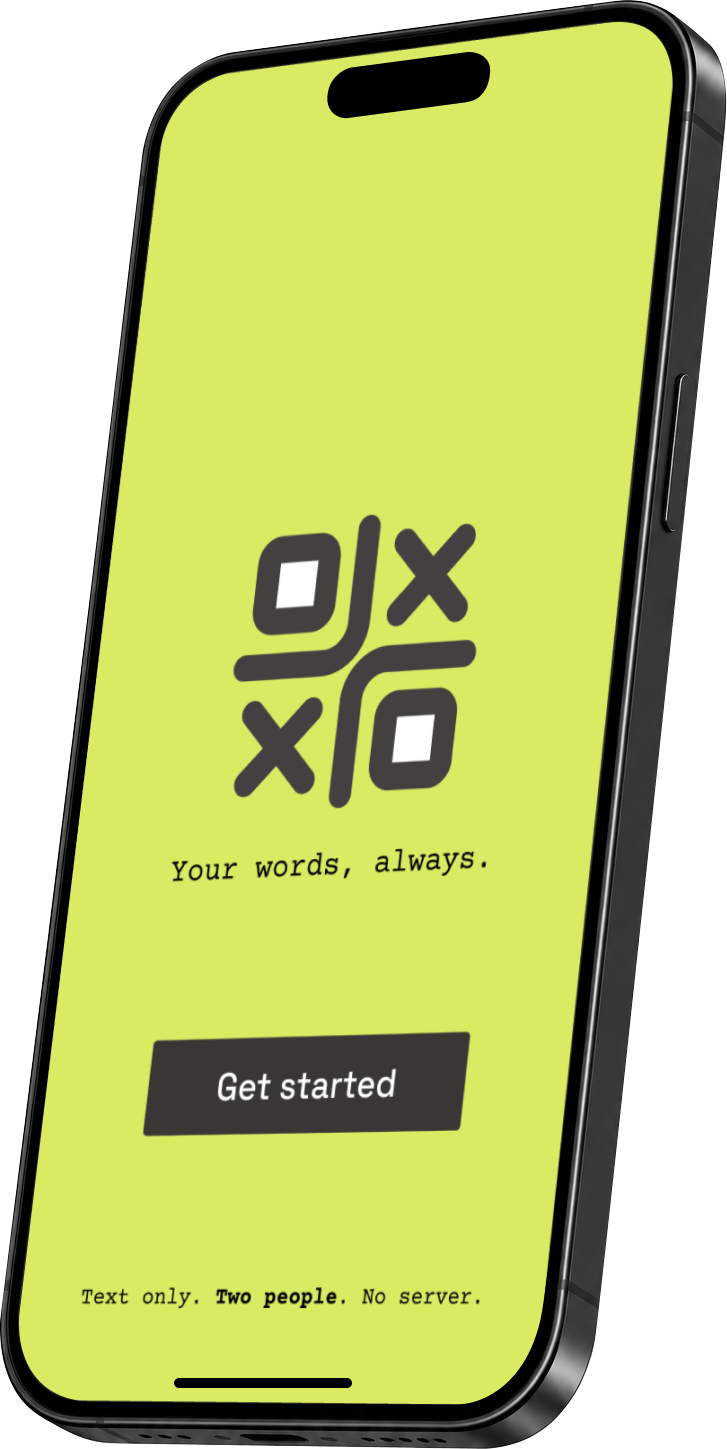
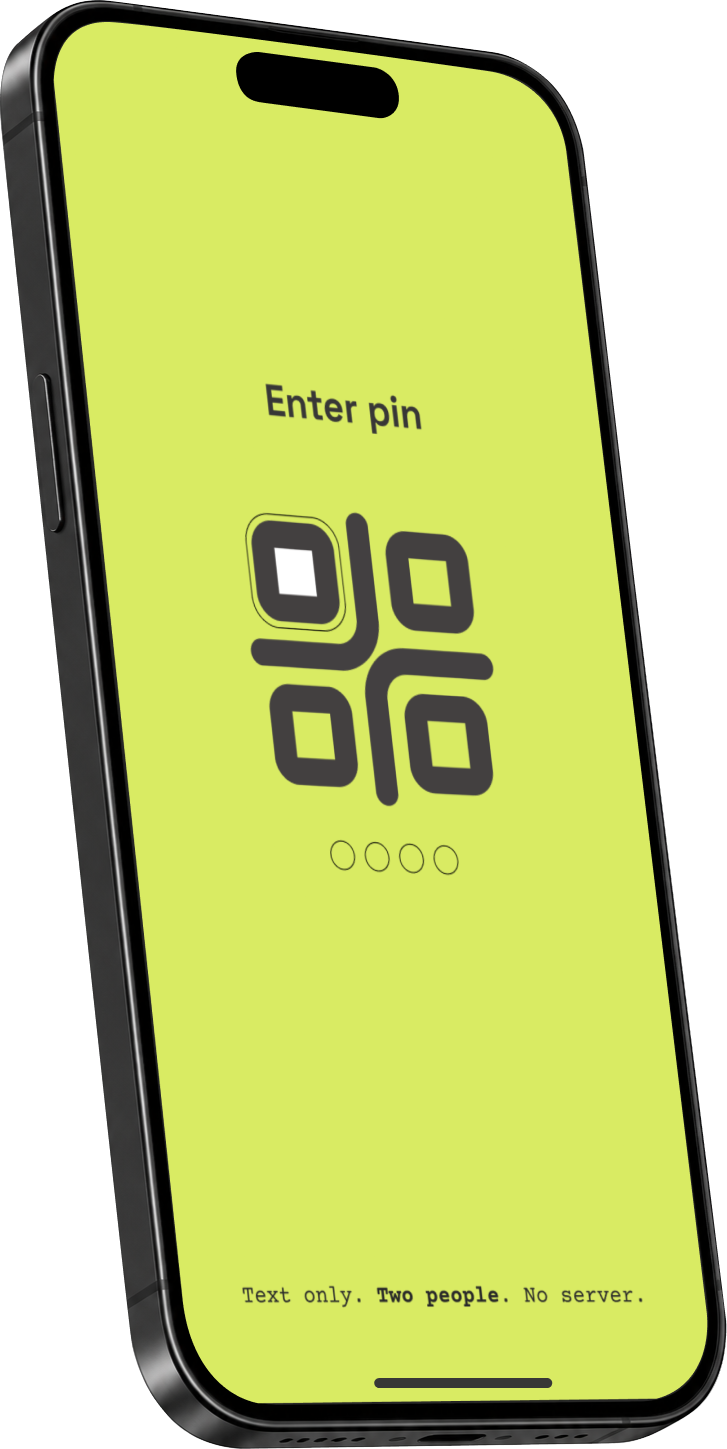
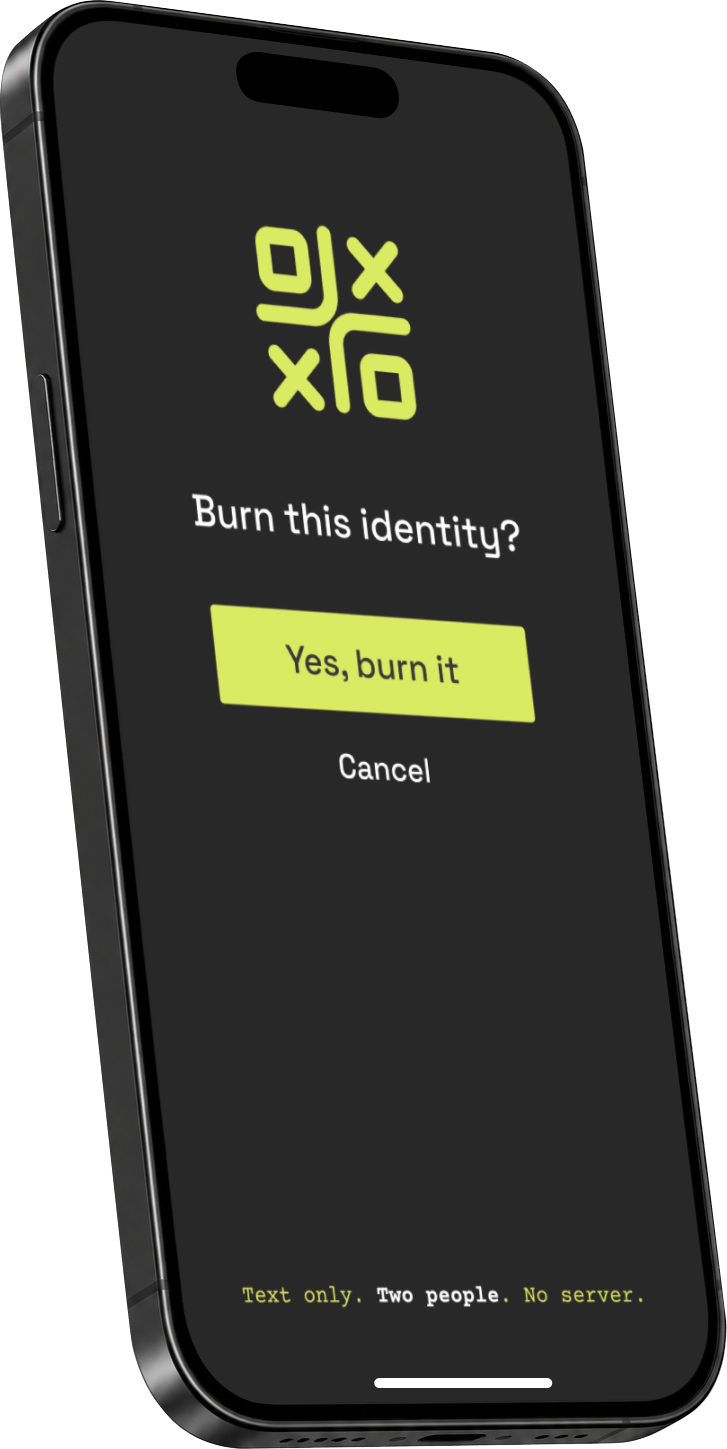
Early concept. Big intent.
Every messaging app you've ever used holds your words somewhere.
- A server
- A database.
- A cloud backup.
They hold them because their business depends on having them. You hand your words to a platform and hope they look after them.
This app is built on a different premise. Your words belong to you.
Read our storyUI subject to change
Text only.
The app is built around words and nothing else.
One
conversation per pair. One device per person. What you send, you can
take back. Your words, always.
Intentional by design
- No images.
- No video/audio.
- No files.
Two people.
You find people the way old school spies found each other — a deliberate meeting, a QR code scanned, a connection made.
There is no username search, no directory, no server that knows who you're looking for. The relay never learns how two people found each other — because they found each other before they ever touched the app.
You choose
- Who gets your QR code.
- Who you meet.
- Who gets your words.
No server.
When you say something, it lives on two devices — yours and the person you chose to speak to. Nowhere else.
The relay that connects you carries your words for a moment — encrypted, unreadable, not even to us — and then lets them go.
Built on ownership
- Nothing to breach.
- Nothing to subpoena.
- Nothing to exit later.
No email.
No phone number.
No verification.
There is no account in the traditional sense — because an account is just a way for a platform to know something about you.
With XOs you choose a name. Your device generates a cryptographic key. That key is your identity, owned entirely by you, stored only on your device, and never seen by any server.
We cannot recover it because we never had it. That is not a limitation. That is ownership.
UI subject to change
No app store.
There is no App Store listing. No gatekeeper between you and the app. No platform that can remove it, restrict it, or impose its own terms on how it works.
It installs directly — from this page, onto your device, in seconds.
Nothing
- No App Store account.
- No review process.
- No middleman.
No tracking.
Most apps know who you talk to, when you open them, and how long you stay. That information is valuable — and they are in the business of collecting it.
We collect nothing about you.
Nothing collected
- No activity logs.
- No contact graphs.
- No data to sell.
Your words, always.
You can redact anything you've sent.
Not unsend. Redact — like a top secret classified document. The
message is removed from their device.
Your record stays, marked as redacted,
because they were your words to begin with.
They still are.
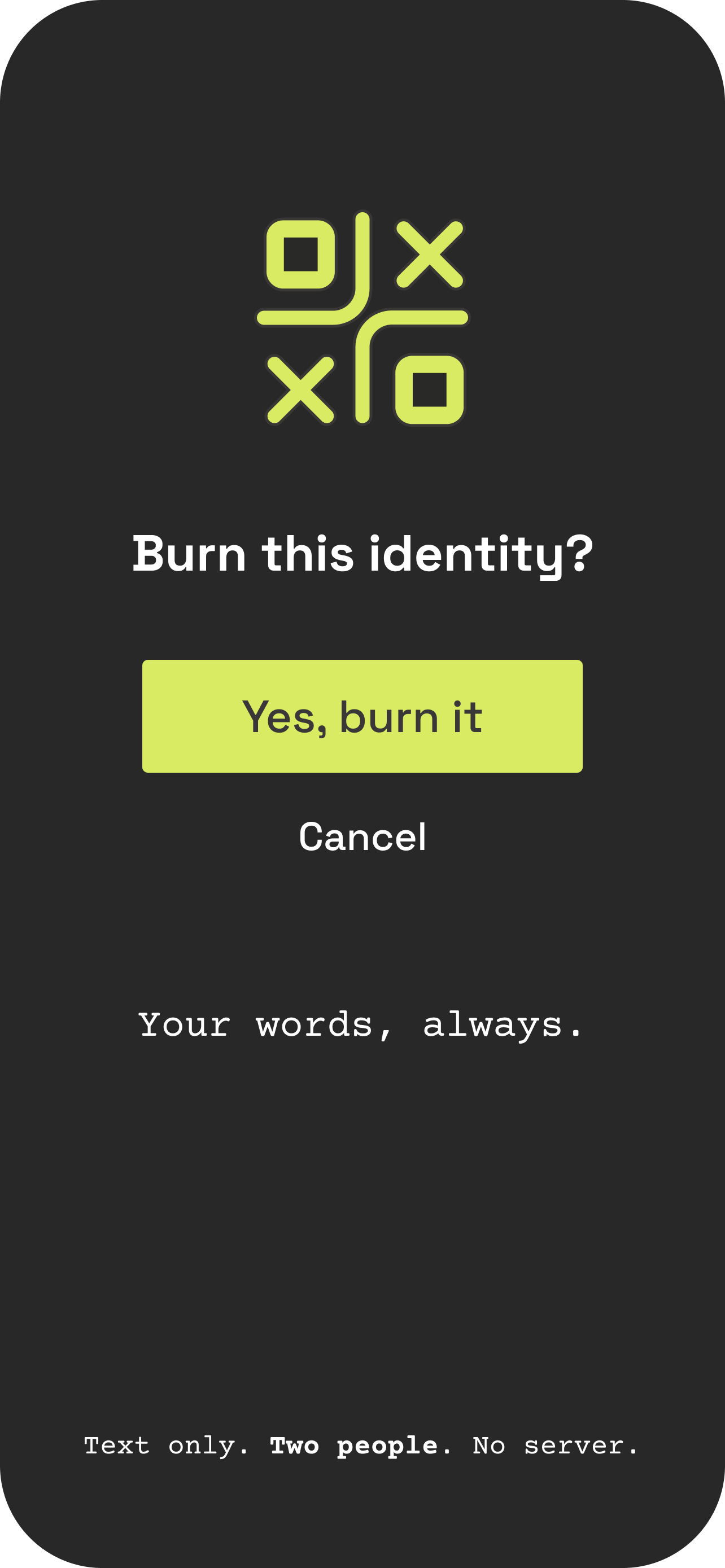
One message. Your entire side of a conversation. Or burn your identity completely — destroying every trace across every conversation you've ever had, simultaneously, with no record connecting the old you to the new.
The best discoveries are rarely advertised.
Ownership doesn't expire.
On Trust.
This app works the way a conversation between two people has always worked — before platforms, before clouds, before any of it.
When you tell a friend something in confidence, you trust them not to repeat it. Sometimes they do. This app cannot change that.
What it can do is remove every layer between you and that human reality.
No company holds your words. No server stores your conversations. No platform profits from knowing who you speak to.
The infrastructure will never be the weak point.
The trust that remains — the only trust that has ever really mattered — is the trust between you and the person you chose to speak with.
What's Been Built.
This is a living record. The foundation has to come before messaging can be built at all: identity, security, the means of finding another person, and an honest account of what the product can and cannot promise. Messaging is next.
Already built
- Pre-launch marketing website with FAQ entries and full copy
- Account creation with cryptographic identity generation — no email, no phone number, no third-party service
- App lock with biometric authentication and PIN fallback
- Key export and import — encrypted with the user's PIN, with a restore flow for new devices
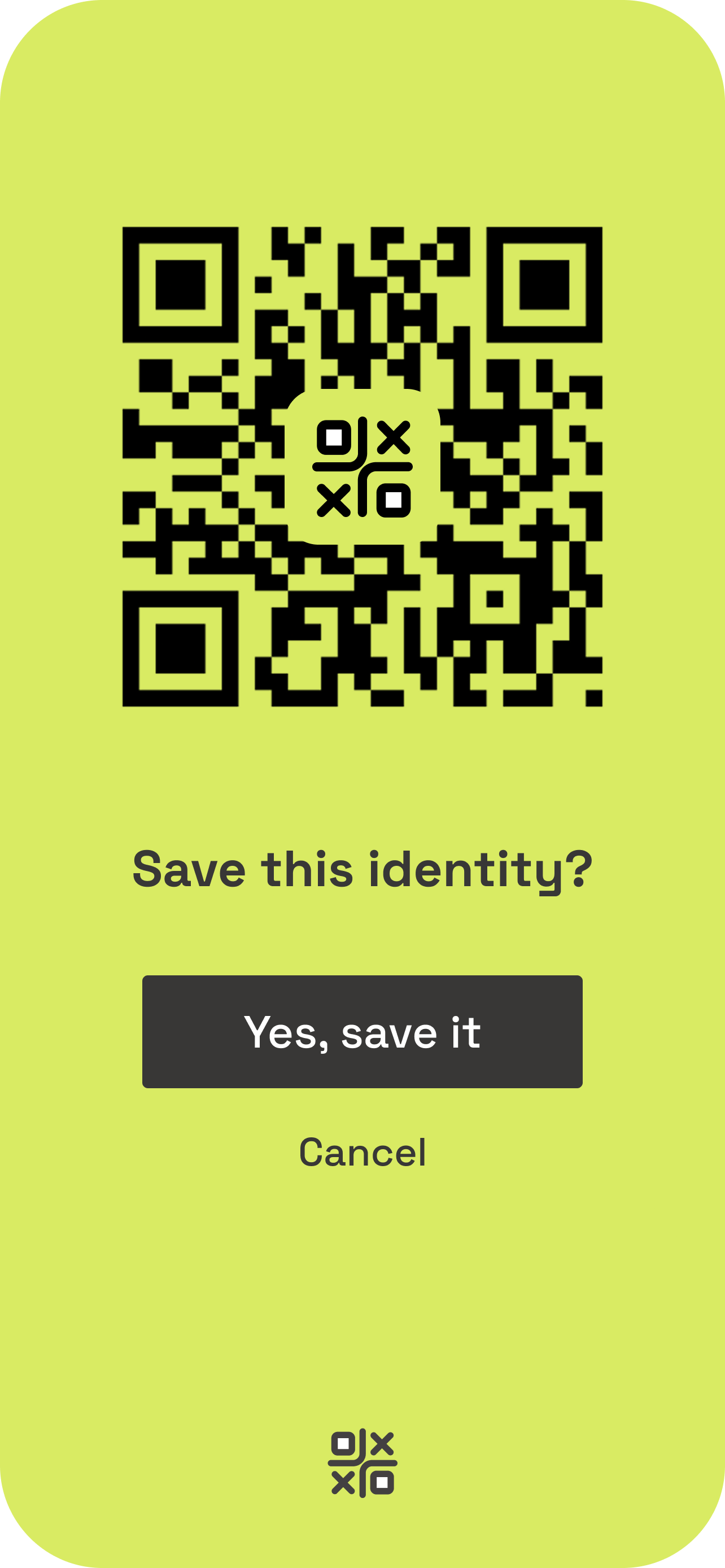
- Personal QR code with a shareable styled card — the only way two people connect in XOs
- QR code scanning to add contacts — camera and file import, with own-code detection and payload validation, completing the in-person connection flow
- Onboarding disclosure screen with a language toggle (plain / technical) and a scroll gate before confirmation
Still to come
- Building the relay
- Building the messaging functionality
- Designing and implementing the interface
Every feature is tracked in a structured spec format: proposal, design, implementation tasks. The spec records not just what was built and how, but why each decision was made — and which decisions were explicitly declined and why. The reasoning is part of the record.
What this app should never be.
Your words are always yours. That means some things are simply off
the table.
So this app will never be:
- A platform.
- A network.
- A group chat.
- A broadcasting tool.
- An app that holds your conversations somewhere you'd ever need to leave.
- A service that knows more about you the longer you use it.
- Something that needs an App Store account before you can even try it.
- A place where your words belong to the platform the moment you send them.
- A product that trades in your attention, your data, or your identity.